

06 May Guatemala wrapped its arms around my soul
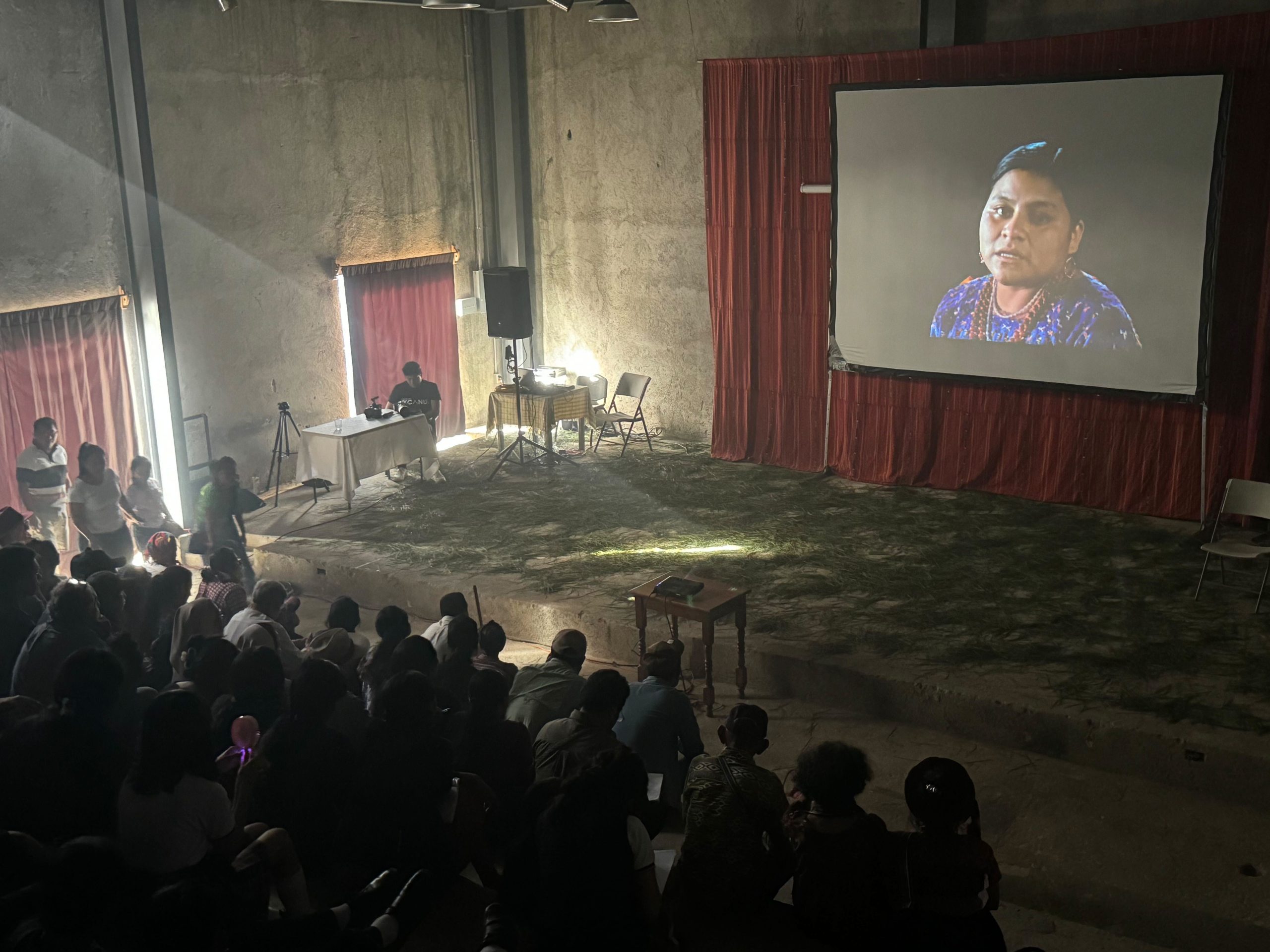
This past February, I criss-crossed Guatemala for more than a week on tour, organized in collaboration with our partners at the Fundación Ixcanul, commemorating the 40th anniversary of When The Mountains Tremble.
I’ve always been struck and somewhat mystified by how Guatemalans have responded to When the Mountains Tremble so enthusiastically across the generations. It was my, and Skylight’s, first feature-length documentary film, but Tom Sigel’s magisterial cinematography and Peter Kinoy’s editing acumen became readily apparent, and our breakthrough decision to film Rigoberta Menchú in a liminal space speaking directly to audiences, brought a deep level of intimacy in telling her story of the Mayan people and the atrocities they suffered.
The subsequent films which came to form The Resistance Saga trilogy, Granito: How to Nail a Dictator and 500 Years, are more cinematic and more complex, but they build on the raw intensity of the historical memory that When the Mountains Tremble delivers with its deep access to both the guerrillas and the army in the armed conflict.
After speaking with hundreds of people at sold out shows across Guatemala, I’ve come to understand that it’s not just the film, but people’s relationship to a time and to a movement that the official history has tried to erase. New generations of Guatemalans are connecting to the visceral scenes in the film. They were seeing for themselves a time they had only heard about, passed down in lore by their grandparents, parents, and community elders. They saw on screen the historical memory that so powerfully grips the present they now inhabit.
The history books say the genocide never happened. Guatemalan and international “experts” say that indigenous people were caught between the guerrilla forces and the army, that they had no agency, no leadership, that Rigoberta Menchú spoke as an individual and not collectively. And that what happened back then is irrelevant to today. But our filmed images from the early 1980s remain a rare archive.
A highlight of the tour was the decision by the Guatemalan Academy of Motion Picture Arts and Sciences to present a special award to us by actor and Aj’ Q’ij (a Mayan spiritual guide), Enrique Salanic. At the ceremony, Enrique said:
“Forty years after [the] premiere [of When the Mountains Tremble], we believe it is time to pay tribute to you for your invaluable contribution, not only to cinema, but also to the struggle for justice and memory in Guatemala. We also recognize your courage in seeking and creating solidarity, taking it to other countries around the world. We are honored to have your presence to celebrate this legacy that continues to generate awareness and social memory.
Sibalaj Maltyox.
Thank you very, very much.Kamik, jun kotz’i’j tajin keluloq pa ri kibaqil ri qati’t qamam.
Today flowers are sprouting from the bones of our grandmothers and grandfathers.”
Watch Enrique’s full remarks here
A profound moment of the tour was coming together with Nobel Laureate Rigoberta Menchú Tum who, as a 22 year old little-known human rights defender, was the lead protagonist and storyteller in When the Mountains Tremble. She hosted the film for hundreds of students at the Pavorotti Educational Center on Lake Atitlán. Though we’ve stayed connected as friends and human right defenders throughout the years, this screening was outstanding, and Rigoberta was at her best.
The tour, the film, and the conversations were a look at the past that has a special resonance for today and shows a path forward. As I often say, “Guatemala wrapped its arms around my soul and never let me go.”
In the short film that synopsizes the whole tour (embedded above), you’ll hear from Rigoberta Menchú, Irma Alicia Velásquez Nimatuj, Enrique Salanic, Alba Carrasco, Gabriela Porras, Margarita Kenéfic, Anaïs Taracena, Daniel Pascual, Don Agustín Aj Piox, Carlos Chen, Mónica Raxcacó, Victoria Hernández, Victoriano Castillo, as well as myself.
Thanks to Maxh Canil Menchú and Chahim Salquil Bin of the Rigoberta Menchú Tum Foundation, Matisse Bustos and Valentina Vargas of Skylight, Raul Socon, Hugo Linares, Juan Pablo Garrido, Roberto Chávez, Magali Ajuchán, Danna Canek, and ADIVIMA as well as the Pavorotti Educational Center, the Spanish Cultural Center, the Community Museum of Historical Memory of Rabinal, Rafael Landivar University, Plaza Pública, Guatemalan Academy of Motion Picture Arts and Sciences, and of course, Paco de Onís.
Above all, thanks to the Fundación Ixcanul for organizing the tour. It took a committed collective of people around the country, working in unison to make this happen.

